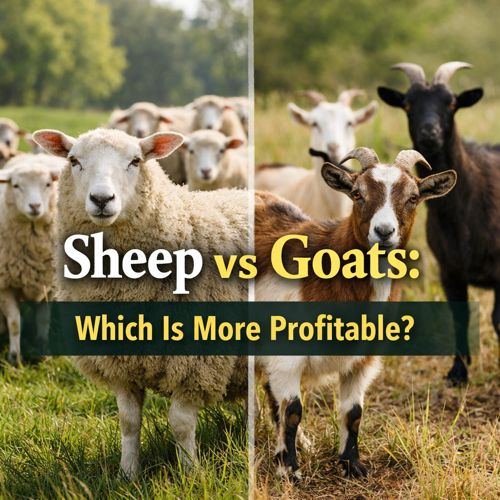
Sheep vs Goats: Which Is More Profitable?
Don’t let paperwork hold you back. Empower your farm, save time, and grow smarter. Download now!
Choosing between sheep and goats is one of the biggest decisions a livestock farmer can make. Both animals offer income opportunities through meat, milk, fiber, and breeding stock sales. Profitability depends on several factors, including feed efficiency, market demand, reproduction rate, land availability, and management requirements. Many beginners enter small ruminant farming without fully comparing these elements, which can lead to unexpected costs or lower returns.
Understanding the financial strengths and challenges of each species helps farmers make informed decisions. This guide compares sheep and goats in practical terms, focusing on real-world profitability factors. By the end, you will have a clearer picture of which option aligns best with your resources, climate, and market conditions.
Market Demand and Product Opportunities
Profit begins with demand. Sheep are widely raised for lamb and mutton, and in some regions wool production adds another income stream. Markets that value lamb during religious festivals or seasonal celebrations often create strong price spikes. Wool breeds can generate annual shearing income, though global wool prices fluctuate depending on textile industry demand.
Goats are highly valued for chevon, which is goat meat. In many parts of Africa, Asia, and the Middle East, goat meat commands premium prices due to cultural preference. Dairy goat farming is expanding rapidly as demand for goat milk, cheese, and yogurt grows among health-conscious consumers. Goat milk is often easier to digest for some individuals, increasing niche market opportunities.
In areas where goat meat prices are higher than lamb prices, goats may generate stronger returns. Where wool markets remain stable, or lamb demand is high, sheep may offer consistent income.
Reproduction Rate and Herd Growth
Reproduction rate has a direct impact on profitability. Goats tend to have higher twinning rates compared to many sheep breeds. Some goat breeds frequently produce twins or triplets, allowing faster herd expansion and more animals available for sale.
Sheep also produce twins, though rates vary by breed and nutrition level. Intensive sheep breeding programs can increase lambing percentages significantly. Gestation periods are similar for both species, averaging around five months.
Faster herd growth means more sales opportunities within a shorter time frame. Goats often provide quicker expansion for small-scale farmers aiming to grow their operations rapidly.
Feed Efficiency and Feeding Costs
Feed cost is one of the largest expenses in livestock farming. Sheep are primarily grazers and perform well on pasture-based systems. They efficiently convert grass into meat and wool, making them suitable for farms with abundant grazing land.
Goats are natural browsers. They prefer shrubs, leaves, and woody plants rather than grass alone. This makes goats well-suited for areas with bushy vegetation or marginal land where sheep may struggle. Goats can utilize diverse plant sources, reducing feed waste in certain environments.
In regions with good pasture availability, sheep may have lower feeding costs. In semi-arid or bush-dominated areas, goats often adapt better and maintain body condition with fewer purchased inputs.
Housing and Infrastructure Requirements
Goats are known for their agility and curiosity. They require strong fencing because they tend to jump or climb. Poor fencing can result in crop damage and neighbor disputes, which increase hidden costs.
Sheep are generally easier to contain and less likely to escape. Their fencing requirements are simpler in many cases. Housing needs are similar for both species, with dry, well-ventilated shelters being essential to prevent disease.
Infrastructure costs can affect initial investment. Farmers with limited capital may find sheep slightly easier to manage in enclosed pasture systems.
Disease Resistance and Veterinary Costs
Health management influences long-term profit. Goats are often considered hardy animals, though they can be more sensitive to wet and cold conditions. They are prone to internal parasites in humid climates.
Sheep are also vulnerable to parasites and certain diseases, such as foot rot, especially in wet environments. Regular deworming, vaccination, and proper pasture management are necessary for both species.
Veterinary costs depend heavily on management practices. Farms with strong biosecurity and routine health checks reduce treatment expenses. Neither species is automatically cheaper in terms of medical care, as management quality determines outcomes.
Labor and Management Intensity
Goats are active and inquisitive animals that require close supervision. They can damage crops, trees, and fencing if not properly managed. Dairy goats require daily milking, which increases labor demands.
Sheep raised for meat or wool often require less daily handling. Wool breeds need annual shearing, which adds seasonal labor costs. Meat sheep systems are typically less labor-intensive compared to dairy goat operations.
Farmers with limited labor availability may prefer sheep. Those willing to invest more time into management may benefit from dairy goat income streams.
Initial Investment and Startup Costs
Startup costs include purchasing breeding stock, building housing, installing fencing, and securing feed supplies. Goat breeding stock may cost more in regions where demand is high. Dairy goat breeds especially command premium prices.
Sheep prices vary depending on breed and wool or meat value. In many regions, sheep are more widely available, which can lower initial purchase costs.
Evaluating local livestock prices before starting helps determine which species requires less upfront capital.
Climate Adaptability
Climate plays a major role in profitability. Goats perform well in hot and dry climates, thriving in rugged terrains where other livestock struggle. Their browsing behavior allows them to survive in diverse landscapes.
Sheep adapt well to temperate and cooler climates, particularly wool breeds that tolerate cold conditions effectively. In extremely wet areas, both species require careful parasite management.
Matching livestock choice to local climate reduces stress, disease risk, and feed costs.
Income Diversification
Sheep can provide income from meat, wool, and breeding stock. Some dairy sheep breeds also produce milk for specialty cheese markets. Wool adds a secondary revenue stream in certain regions, though profitability depends on market stability.
Goats offer meat, milk, breeding stock, and sometimes fiber such as mohair or cashmere, depending on breed. Dairy goats allow farmers to create value-added products like cheese and yogurt, which may increase profit margins.
Diversified income sources reduce financial risk and improve overall farm stability.
Profit Margin Comparison
Determining which animal is more profitable depends largely on market prices, feed availability, management skill, and local demand. In regions where goat meat prices are significantly higher than lamb prices, goats often deliver stronger returns per animal. Their higher reproductive rates also increase total sales volume.
In pasture-rich environments with strong lamb markets, sheep can generate steady profits with lower fencing challenges. Wool-producing flocks can add extra revenue in areas where textile markets remain strong.
Profitability is influenced more by management efficiency and market access than by species alone.
Profit Per Acre: Which Animal Generates More Income on Limited Land?
Profit per acre is one of the most important factors for small and medium-scale farmers. Sheep perform best on well-managed grass pasture. If your land produces strong grass growth throughout the year, sheep can convert that forage into meat efficiently. In high-quality pasture systems, farmers can maintain moderate stocking density and achieve consistent lamb production.
Goats, on the other hand, thrive in areas with shrubs, bushes, and mixed vegetation. They utilize browse that sheep often ignore. This makes goats highly profitable on marginal land where grass production is limited. In regions with bush-dominated landscapes, goats may generate better returns per acre because they turn underutilized vegetation into marketable meat or milk.
The type of land you own strongly influences which animal delivers better financial performance.
Which Is Better for Beginners?
Beginners often ask whether sheep or goats are easier to manage. Sheep are generally calmer and easier to contain. They follow flock behavior and adapt well to rotational grazing systems. For farmers with basic fencing and grass pasture, sheep can be simpler to manage in the early stages.
Goats are intelligent and curious animals. They require strong fencing and closer supervision. Dairy goats demand consistent milking schedules, which increases daily labor requirements. Meat goat systems are less labor-intensive than dairy operations.
For beginners with limited experience, sheep may feel more manageable. For farmers willing to invest time in fencing and active supervision, goats can deliver strong financial returns.
Conclusion
The debate between sheep vs goats profitability does not have a universal answer. Goats often offer faster herd growth, strong meat demand in many regions, and adaptability to marginal land. Sheep may provide easier management, lower fencing costs, and additional wool income in suitable climates.
The most profitable choice depends on your land type, available feed resources, climate conditions, labor capacity, and target market. Careful planning, consistent health management, and strategic marketing determine long-term success more than the animal itself.
Before investing, analyze local market trends, calculate projected costs, and evaluate your management capacity. When aligned with the right environment and business strategy, both sheep and goats can become highly profitable livestock enterprises.
Join Our Community ()
Farming smarter isn’t a dream—it’s a tap away. Organize, automate, and grow with our apps. Start today!
