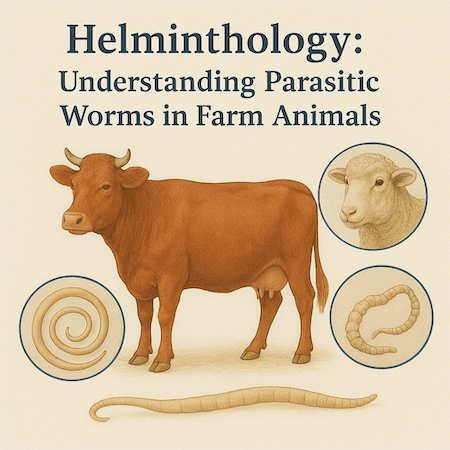
Helminthology: Understanding Parasitic Worms in Farm Animals
No more endless forms, no more confusion. Our apps are your lifeline for a paperless, productive farm. Start now!
Livestock farming is the backbone of food production in many parts of the world, yet it faces constant threats from parasites that silently reduce animal health and productivity. Among the most important parasites are helminths, commonly known as parasitic worms. These organisms live inside animals, feeding on their blood, tissues, or digested food, and in doing so, they cause diseases that can range from mild weakness to sudden death.
The study of these worms is called helminthology. For veterinarians and farmers alike, understanding helminths is essential because their impact stretches beyond animal health to farm profitability and food security. Losses from worm infestations include reduced weight gain, poor milk production, lowered fertility, and higher susceptibility to other diseases.
This article provides a detailed yet practical explanation of parasitic worms, their classification, how they affect livestock, and what farmers can do to prevent and control them.
Classification of Helminths
Helminths are divided into three main groups of veterinary importance:
- Nematodes (Roundworms)
- Cylindrical, unsegmented worms with separate sexes.
- Common examples: Haemonchus contortus (barber’s pole worm), Dictyocaulus viviparus (lungworm), Ascaris suum (pig roundworm).
- Platyhelminthes (Flatworms)
- Flat, bilaterally symmetrical worms.
- Divided into two classes:
- Trematodes (Flukes): e.g., Fasciola hepatica (liver fluke).
- Cestodes (Tapeworms): e.g., Moniezia expansa (ruminant tapeworm).
- Acanthocephala (Thorny-headed worms)
- Rare in veterinary practice, of little importance compared to nematodes and flatworms.
General Features of Helminths
Nematodes (Roundworms)
- Cylindrical body, tapering at both ends.
- Separate sexes (male and female).
- Complete digestive system (mouth to anus).
- Most have direct life cycles; the L3 larval stage is often the infective form.
Platyhelminthes (Flatworms)
- Flat body shape (leaf-like or ribbon-like).
- Usually hermaphroditic.
- Most require intermediate hosts for part of their lifecycle.
Trematodes (Flukes)
- Leaf-shaped (except Schistosomes).
- Possess suckers for attachment.
- Indirect life cycle involving snails as intermediate hosts.
- Example: Fasciola hepatica in cattle and sheep.
Cestodes (Tapeworms)
- Long, ribbon-like, segmented worms.
- Lack a digestive system – absorb nutrients through their body surface.
- Require intermediate hosts (e.g., mites, rabbits).
- Example: Taenia spp. in dogs, Moniezia spp. in ruminants.
How Worms Infect Livestock
Helminths gain entry into animals through several routes:
- Oral ingestion – animals eat infective larvae from contaminated pasture, feed, or water.
- Skin penetration – some larvae penetrate directly through the skin (common in hookworms).
- Vector transmission – spread via intermediate hosts like snails, earthworms, or insects.
Once inside the host, larvae often migrate through tissues before reaching their preferred site (e.g., intestines, lungs, liver). For example, Ascaris suum in pigs follows the hepato-tracheal route, traveling from the gut to the liver, then lungs, and finally back to the intestine.
Effects of Worms on Livestock
Helminths affect animals in multiple ways:
- Blood loss – e.g., Haemonchus contortus sucks blood in the abomasum of sheep and goats.
- Tissue destruction – migrating larvae damage vital organs like the liver (Fasciola spp.) or lungs (Dictyocaulus spp.).
- Obstruction – large worms may block intestines (Ascaris suum) or blood vessels (Strongylus vulgaris).
- Nutrient competition – parasites compete with the host for food, leading to poor growth.
- Secondary infections – worm-induced tissue damage opens doors for bacterial invasion.
The overall result is reduced productivity, weakness, and in severe cases, death.
Important Helminth Diseases in Livestock
1. Haemonchosis (Barber’s Pole Worm)
- Cause: Haemonchus contortus (sheep/goats) and H. placei (cattle).
- Site: Abomasum (true stomach).
- Lifecycle: Direct; infective L3 ingested from pasture.
- Clinical Signs:
- Severe anemia (pale mucous membranes).
- Bottle jaw (fluid swelling under the jaw).
- Weakness, lethargy, and sometimes sudden death.
- Diagnosis: Fecal egg counts, postmortem (red, spiraled worms in abomasum).
- Control: Strategic deworming, pasture rotation, and selective breeding for resistant animals.
2. Dictyocaulosis (Lungworm Disease)
- Cause: Dictyocaulus viviparus in cattle; D. filaria in sheep and goats.
- Site: Lungs and bronchi.
- Lifecycle: Eggs hatch in airways → larvae are swallowed → passed in feces → develop to L3 → ingested by animals → migrate via lympho-tracheal route to lungs.
- Clinical Signs: Coughing, rapid breathing, nasal discharge, poor weight gain.
- Diagnosis: Baermann technique (recover larvae from feces).
- Control: Vaccination (irradiated larvae in cattle), rotational grazing, deworming programs.
3. Fascioliasis (Liver Fluke Disease)
- Cause: Fasciola hepatica (temperate zones) and F. gigantica (tropics).
- Site: Bile ducts and liver.
- Lifecycle: Indirect, requiring freshwater snails as intermediate hosts.
- Clinical Signs:
- Chronic weight loss.
- Anemia and bottle jaw.
- Reduced milk yield in dairy animals.
- Diagnosis: Fecal examination (fluke eggs), liver lesions at postmortem.
- Control: Control snail populations, drain wet pastures, and use flukicides.
4. Ascariasis (Roundworm Disease in Pigs)
- Cause: Ascaris suum.
- Site: Small intestine (adults), liver and lungs (migrating larvae).
- Lifecycle: Eggs ingested → larvae migrate via the liver and lungs → coughed up and swallowed → adults in the small intestine.
- Clinical Signs: Poor growth, respiratory distress (“thumps”), pot-bellied appearance.
- Diagnosis: Fecal egg counts, characteristic “milk spots” in the liver at slaughter.
- Control: Good sanitation, regular deworming, and avoiding contaminated pastures.
Diagnosis of Helminth Infections
- Fecal Egg Counts (FEC): Identifies eggs of roundworms, flukes, and tapeworms.
- Larval Culture: Helps differentiate between nematode genera.
- Postmortem Examination: Identifies worms directly and the lesions they cause.
Prevention and Control Strategies
Managing worms in livestock requires an integrated approach:
- Anthelmintics (Dewormers): Use strategically to avoid resistance. Rotate drug classes.
- Pasture Management: Rotate grazing fields, avoid overstocking, and rest pastures to reduce larval buildup.
- Breeding for Resistance: Some breeds (e.g., Red Maasai sheep) show natural worm resistance.
- Nutrition: Well-fed animals withstand worm burdens better.
- Vaccination: Available for lungworm (Dictyocaulus viviparus) and under research for Haemonchus.
Conclusion
Helminths are among the most damaging parasites in livestock farming. Their impact is not just on animal health but also on farm productivity and profitability. As a farmer, recognizing the signs of worm infections, working with veterinarians on regular monitoring, and implementing effective prevention strategies can make the difference between losses and profitable production.
By combining good animal husbandry, smart use of dewormers, pasture management, and emerging tools like vaccines, farmers can stay ahead in the fight against these silent but deadly parasites.
Join Our Community ()
Make every moment on your farm count! Simplify, streamline, and succeed. Download our apps now!
